Leone Porciani, University of Pavia
May 21
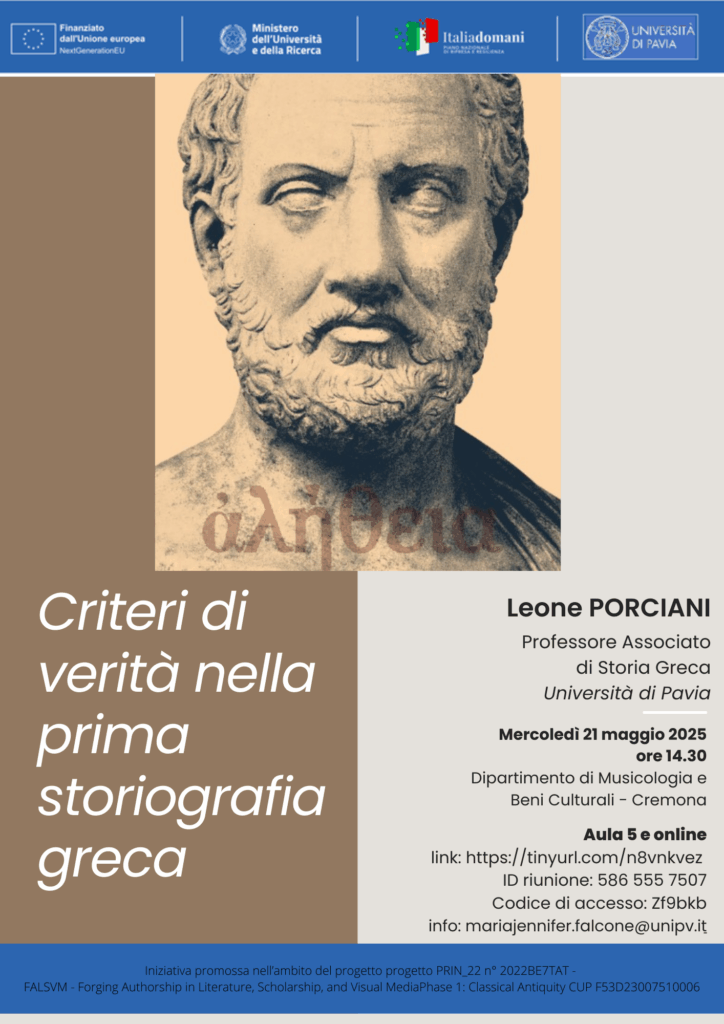
Cercare un buon modo per distinguere il vero dal falso appare un obiettivo del discorso storico fin dalle sue origini: «Ecateo di Mileto così racconta: queste cose io scrivo come mi sembra siano vere, perché i racconti dei Greci, come mi si presentano, sono molti e ridicoli». Da allora, la «verità» è un demone e un idolo che sempre ha accompagnato la riflessione degli storici, chiamati a compiere lo sforzo di dimostrare, argomentare, sceverare il vero dal falso. Ciò che Ecateo, Erodoto e Tucidide sembrano suggerirci è che agli inizi della storiografia la cura della verità si manifesta anche in una forma diversa, a noi poco familiare, nella quale il vero è dichiarato e proclamato prima ancora che dimostrato, e i criteri di verità non sono resi espliciti: a questo peculiare modo di trattare il problema del vero e del falso, che ha un certo rilievo nella fase di sviluppo del genere storiografico, dedicheremo attenzione per comprenderne la funzione e le ragioni.
The search for a reliable way to distinguish truth from falsehood has appeared as a central aim of historical discourse since its very origins: “Hecataeus of Miletus writes as follows: these things I write as they seem to me to be true, for the accounts of the Greeks, as they are presented to me, are many and laughable.” Since then, “truth” has been both a guiding spirit and an idol, ever accompanying the historian’s task: to demonstrate, to argue, to discern the true from the false. What Hecataeus, Herodotus, and Thucydides seem to suggest is that, at the dawn of historiography, the concern for truth also manifested itself in a form unfamiliar to us today—one in which truth is declared and proclaimed even before it is demonstrated, and the criteria of truth are not made explicit. To this particular way of addressing the problem of truth and falsehood—a mode that played a notable role in the development of the historiographical genre—we will devote our attention, in order to understand its function and underlying rationale.
The seminar will take place on Wednesday, 21 May at 2:30 PM in Room 5 of the Department of Musicology and Cultural Heritage. It is the fourth in a series of thematic lectures on the topic of forgery, organised as part of the national PRIN2022 project FALSVM (Forging Authorship in Literature, Scholarship, and Visual Media – Phase 1: Classical Antiquity; CUP F53D23007510006), coordinated in Cremona by Prof. Maria Jennifer Falcone, together with Prof. Elisa Romano (Pavia) and Prof. Elena Merli (University of Milan).