Lorenzo Calvelli, Università Ca’ Foscari, Venezia
13 May 2025
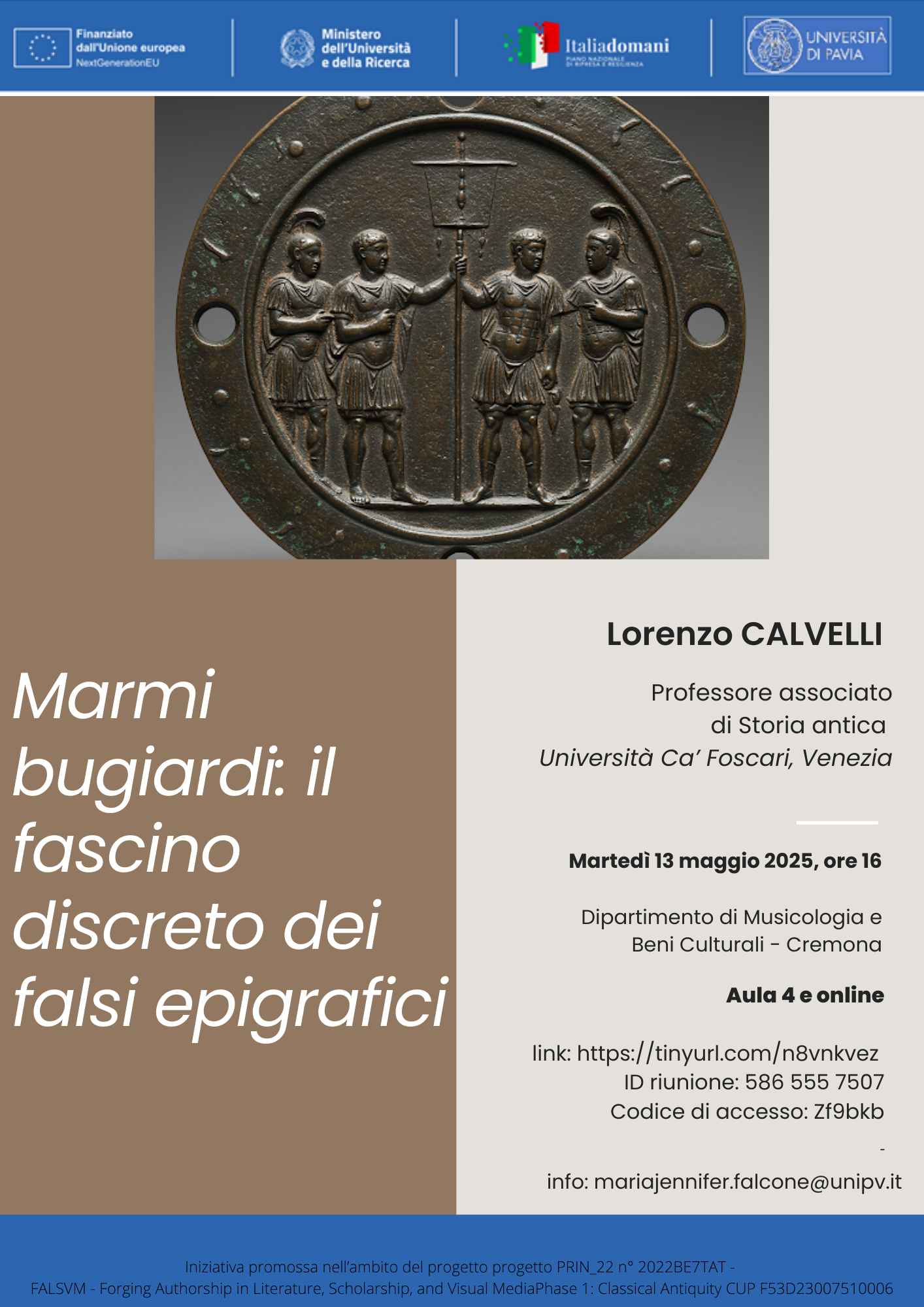
Che cos’è un’iscrizione falsa? E in che modo può essere utile alla ricerca storica? La presentazione affronta il tema delle contraffazioni epigrafiche, valutando la rilevanza e il potenziale critico di questa particolare categoria di fonti. Le falsae non sono un’invenzione moderna: esistevano già in epoca antica e medievale, ma fu a partire dal Rinascimento che il loro numero si impose significativamente. Nell’Ottocento, Theodor Mommsen e gli altri curatori del Corpus inscriptionum Latinarum crearono una vera e propria epistemologia della critica epigrafica, i cui principi, spesso in modo implicito, continuano a orientare le edizioni scientifiche contemporanee. Dopo una riflessione sulla storia della ricerca legata ai falsi epigrafici, presenterò un’esemplificazione incentrata su alcune laminette in bronzo iscritte, oggi conservate in diversi musei europei. Ricostruendone la storia dalle loro prime attestazioni fino ai nostri giorni, cercherò di metterne in discussione la genuinità. Si tratta davvero di documenti antichi o, piuttosto, di affascinanti invenzioni moderne, capaci di ingannare anche gli esperti?
What is a forged inscription? And how can it be useful for historical research?
This presentation explores the topic of epigraphic forgeries, assessing the significance and critical potential of this particular category of sources. Falsae are not a modern invention: they already existed in antiquity and the Middle Ages, but it was during the Renaissance that their number began to grow significantly. In the nineteenth century, Theodor Mommsen and the other editors of the Corpus Inscriptionum Latinarum developed a true epistemology of epigraphic criticism, whose principles—often implicitly—still guide scholarly editions today. After a reflection on the history of research into forged inscriptions, I will present a case study focusing on a number of inscribed bronze tablets now held in various European museums. By reconstructing their history from the earliest attestations to the present day, I will seek to question their authenticity. Are these truly ancient documents, or rather fascinating modern inventions, capable of deceiving even the experts?
The seminar will take place on Tuesday, 13 May at 4:00 PM in Room 4 of the Department of Musicology and Cultural Heritage. It is the fourth in a series of thematic lectures on the topic of forgery, organised as part of the national PRIN2022 project FALSVM (Forging Authorship in Literature, Scholarship, and Visual Media – Phase 1: Classical Antiquity; CUP F53D23007510006), coordinated in Cremona by Prof. Maria Jennifer Falcone, together with Prof. Elisa Romano (Pavia) and Prof. Elena Merli (University of Milan).
It will also be possible to attend the event remotely, via the following link: https://unipv-it.zoom.us/j/5865557507?pwd=WmN0QjFVN3FodnlXekptNFlxaXJWZz09 (ID riunione: 586 555 7507; Codice d’accesso: Zf9bkb).
For information: mariajennifer.falcone@unipv.it.